Trump Jesus AI Image Explained: What Happened, Why It Was Deleted, and Why It Went Viral
A controversial AI-generated image shared by Donald Trump on Truth Social became one of the most talked-about political media stories of April 2026. The post was deleted after backlash, but the debate continued when a second AI image involving Jesus appeared days later.
Reporting synthesized from Reuters, CBS News, People, and The Guardian. All image references on this page are labeled as AI-generated or manipulated where appropriate.
Overview
The controversy centered on an AI-generated image Trump shared on Truth Social on Sunday, April 12, 2026, and which was widely discussed on Monday, April 13. The image used religious visual cues that many people interpreted as portraying Trump in a Jesus-like role. News coverage from Reuters, The Guardian, CBS News, and People framed the incident as a politically explosive mix of religion, symbolism, and AI-generated media.
The story did not stay confined to the original post. After criticism built and the image was deleted, Trump said he believed the image showed him as a doctor or Red Cross-style helper. Then, on April 15, 2026, Reuters and People reported on another AI image involving Trump and Jesus, turning a one-day uproar into a broader story about political messaging, AI visuals, and the speed of online outrage.
- Trump shared an AI-generated image on Truth Social that many readers interpreted as depicting him in a Jesus-like role, then removed it after backlash.
- The deleted image became controversial because critics, including some conservatives and Christians, viewed it as irreverent, attention-seeking, or blasphemous.
- Trump later said he believed the picture showed him as a doctor or Red Cross-style helper, not as Jesus, according to follow-up reporting.
- The story did not end with the deletion. By April 15, 2026, Trump had posted another AI image showing him with Jesus, extending the controversy.
- The images were widely described by news outlets as AI-generated or manipulated, which helped the story spread across politics, religion, and AI-ethics conversations at once.
What image Trump posted
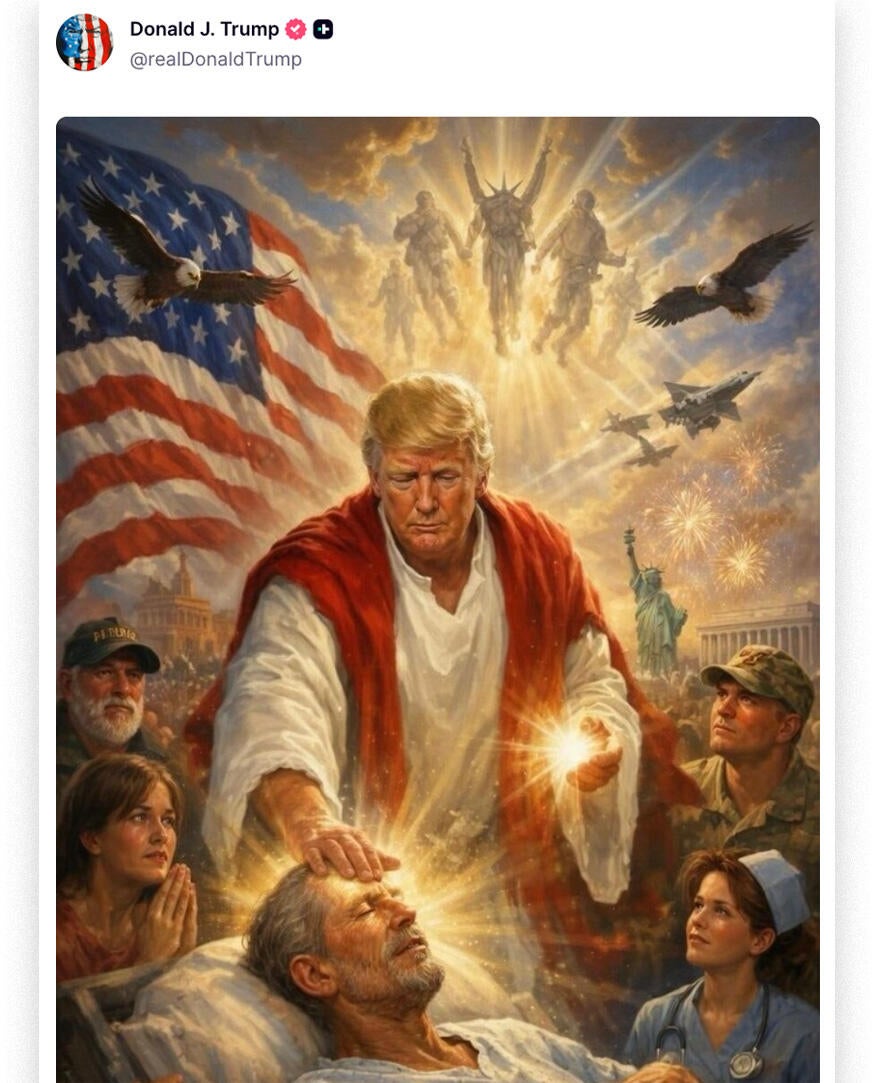
The first image was not a normal campaign graphic. It was an AI-generated or manipulated visual that placed Trump in white robes with a red sash and a healing-style pose. Reports described the composition as intentionally dramatic, with visual symbolism designed to be instantly recognizable and emotionally charged.
That visual language mattered. Even without explicit text saying Trump was Jesus, the styling pushed many viewers toward that interpretation. In practice, political audiences did not read the image as subtle satire or random internet art. They read it as a provocative self-mythologizing image from a former president who already attracts intense attention online.
Which image was deleted
The deleted image was the earlier Jesus-like AI image that Trump reposted on Truth Social and later removed after criticism. Reuters treated that deleted post as the core of the story on April 13, 2026, and that is why the Reuters article is the strongest hero-image reference for this page.
From a search-intent perspective, this matters because many readers are not only asking what Trump posted. They are specifically asking which image disappeared, whether it was removed because of backlash, and whether screenshots of the deleted image reflect the same post described in mainstream reporting. The answer is yes: the deleted image is the AI-generated, Christ-like post that triggered the first wave of criticism.
Sources: Reuters, CBS News
Timeline of events
April 12, 2026
Initial post appears on Truth Social
Trump reposted an AI-generated image that presented him in a white robe and red sash with healing-style visual cues. The timing, on Orthodox Easter, made the post especially sensitive.
April 13, 2026
Backlash builds and the image is deleted
Reuters, The Guardian, CBS News, and others reported that the post drew criticism from political opponents and from some conservative or Christian voices who considered it inappropriate.
April 13, 2026
Trump offers an explanation
Trump said he thought the image made him look like a doctor or Red Cross-type helper and said he removed it because people were confused about what it showed.
April 15, 2026
A second AI image appears
Follow-up coverage from Reuters and People described another AI image showing Trump and Jesus touching heads, signaling that the controversy had evolved instead of ending.
April 15-16, 2026
The story broadens into a media and platform debate
Discussion expanded beyond politics into questions about AI imagery, religious symbolism, virality, and how public figures use manipulated visuals for maximum attention.
Sources: Reuters, People
Why people called it offensive or blasphemous
The backlash was not limited to predictable political critics. A notable part of the reaction came from people on the right, including conservatives and Christians who argued that religious imagery should not be used for presidential self-branding. That reaction gave the story additional weight because it was not just an opposition-media cycle. It became a dispute inside Trump-aligned audiences as well.
Timing intensified the reaction. The post appeared around Orthodox Easter, when Christian symbolism is especially resonant. For some readers, the image looked less like edgy internet trolling and more like a deliberate merging of sacred imagery with political ego. That is why words like offensive, sacrilegious, and blasphemous appeared so quickly in media coverage and social commentary.
Another reason the criticism landed so hard is that the image was simple to understand at a glance. Social media rewards visuals that need little explanation. In one frame, viewers saw a famous political figure, a familiar sacred reference, and a possible violation of cultural boundaries. That combination almost guarantees rapid circulation.
Sources: Reuters, The Guardian, CBS News
Trump's explanation
Trump did not accept the idea that he had posted an image of himself as Jesus. Follow-up reporting summarized his response this way: he said he thought the image showed him as a doctor, healer, or Red Cross-style helper and suggested that the more religious interpretation came from hostile media coverage. He also said the post was removed because people were confused by it.
That explanation did not fully resolve the controversy because the symbolism was so obvious to many viewers. Once a public audience collectively attaches a meaning to an image, the original poster loses some control over the narrative. In this case, Trump's explanation became part of the story rather than the end of it.
Sources: People, CBS News
Connection to the broader religious and political context
This episode spread in part because it fit into larger debates already underway. Trump's public clashes with religious leaders, ongoing tensions about the role of Christianity in U.S. politics, and broader arguments over symbolic politics all gave the image a ready-made context. By mid-April, reporting was already connecting the second AI image to a wider dispute over Trump, religion, and criticism tied to the papacy.
In other words, people were not reacting to one isolated meme. They were reacting to a visual that seemed to sit inside a much larger struggle over identity, authority, faith, and political theater. That is one reason this story reached well beyond Trump supporters and detractors and into mainstream culture coverage.
Sources: Reuters, The Guardian
Are the images real or AI-generated?
The short answer is that the images at the center of the controversy were described as AI-generated or manipulated. Readers should not treat them as evidence that a real event happened or that an actual photograph captured Trump in a religious scene. They are synthetic visuals used in a political communication environment that increasingly blends memes, propaganda, satire, and promotion.
This distinction matters for both journalism and SEO. News audiences often search terms like “Is the Trump Jesus image real?” because viral image controversies move faster than verification. A useful explainer has to answer that question clearly: the controversy is real, the post was real, the backlash was real, but the central visual itself was not a documentary photograph.
Fact Check
The image shown on this page is included as reporting context for a real news event. It is not presented as a real documentary photograph and should be understood as AI-generated political imagery.
FAQ
Did Trump post an AI image with Jesus?
Yes. Multiple outlets reported that Trump shared AI-generated imagery that viewers read as depicting him in relation to Jesus or in a Jesus-like visual frame.
Was the Trump Jesus image real?
No. The image was described by news outlets as AI-generated or manipulated. It should not be treated as a documentary photograph of a real event.
Why was the image deleted?
The post was deleted after backlash. Trump later said he removed it because people were confused about what the image was supposed to represent.
What did Trump say about the backlash?
He said he believed the image showed him as a doctor or healer rather than as Jesus and dismissed the negative interpretation as media spin.
Why did some people call the image blasphemous?
Critics argued that pairing presidential self-promotion with sacred Christian imagery crossed a line, especially around Easter-season religious observance.
Did Trump post another image after deleting the first one?
Yes. Reuters and People reported on a later AI image showing Trump and Jesus touching heads, which kept the story alive.
Why did the controversy spread so fast online?
It combined several high-velocity topics at once: Trump, religion, AI-generated content, platform repost culture, and an easily shareable image controversy.
Conclusion
The Trump Jesus AI image controversy became bigger than a single deleted post because it sat at the intersection of politics, religion, platform behavior, and AI-generated media. The original image drew backlash, the deletion raised more questions, Trump's explanation failed to settle the matter, and a second AI image kept the story in motion.
For readers searching this topic now, the clearest summary is simple: Trump did share an AI-generated image that many people interpreted as Jesus-like, the post was deleted after criticism, he said the image was misunderstood, and the broader controversy kept evolving across April 13-15, 2026.
Sources and references
- Reuters: Trump posts AI image of himself as Jesus-like figure, drawing outrage
- People: Trump posts new AI image of him and Jesus touching heads
- People: Trump says he thought the AI Jesus photo showed him as a doctor
- Reuters: Trump posts image of himself with Jesus as criticism continues
- The Guardian: Trump deletes post with AI image of himself as Jesus-like figure after outcry